
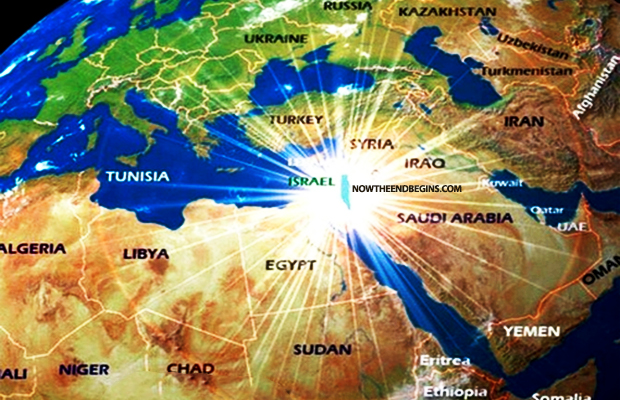

The regathering of Israel is an often repeated prediction of the Bible, mentioned in a multitude of passages. The Jews were globally dispersed for 1,900 years, and yet, during that time they were able to retain their cultural and religious identity. In recent years, they were reestablished as a nation against all odds. This would be about as likely as the Native Americans being given back their land in the United States! In fact, that would be more likely—given the fact that the Native Americans were not globally dispersed for almost two millennia.
Let’s consider the predictions that the Bible makes in this regard. Below is a partial list of verses that predict the regathering of Israel. For more passages, see the endnote.[i]
The Regathering in Isaiah

Let’s look at this passage closely:
(Is. 11:11-12 NASB) Then it will happen on that day that the Lord will again recover the second time with His hand the remnant of His people, who will remain, from Assyria, Egypt, Pathros, Cush, Elam, Shinar, Hamath, and from the islands of the sea. 12 And He will lift up a standard for the nations, and will assemble the banished ones of Israel, and will gather the dispersed of Judah from the four corners of the earth.
First, this cannot refer to the regathering under Ezra and Nehemiah, because he clearly says that they will be regathered “a second time.” Isaiah was writing before the first dispersion under Nebuchadnezzar (8th century B.C.). The return from Babylonian and Assyrian exile was the “first regathering” (Is. 10:20-27; 44:26-45:8). Moreover, this cannot refer to the regathering of the Exodus under Moses, because Isaiah promised a “remnant” will be regathered. The Exodus was not a remnant –rather all of Israel was gathered.
Second, this passage states that this will be a global regathering (“from the islands of the sea… from the four corners of the earth”), rather than a local regathering.
Third, the context explains that this is a global regathering at the end of history. In verses 1-5, Isaiah speaks of the Branch (the Messiah). In verses 6-9, he speaks of the Messianic kingdom. In verses 10-16, he speaks of the political or physical regathering of Israel. In chapter 12:1-6, he speaks of the spiritual regathering in Israel.[1] This is during the time of King Messiah (v.10). Isaiah mentions the “Root of Jesse,” which is synonymous with the Messiah.
Fourth, he mentions the specific countries from which the Jews will return. Regarding the first regathering under Ezra and Nehemiah, Eugenie Johnston writes:
About 50 thousand Jews from Babylon returned immediately under Zerubbabel (Neh. 7:6-7, 66-67). Nearly a century later, Nehemiah led another group from Shushan in Persia (Neh. 1:1; 2:1-11). No other places are mentioned from which Jews returned. Among the names of Jews who returned, we find a number of Babylonian and Persian names, indicating that the Jews had lived in these areas, but no evidence of return from other regions.[2]
Today, we see that there has been an exodus from these specific countries that Isaiah had predicted:
Statistics on Regathering from the Nations |
||
Nation |
Jewish Population (1948) |
Jewish Population (Today) |
|
Egypt |
66,000 Jews. |
A few hundred.[3] |
|
Assyria & Babylon (modern day Iraq) |
150,000 Jews |
Fewer than 10![4] |
|
Hamath (modern day Syria) |
15,000 Jews. |
Fewer than 100.[5] |
|
Elam (modern day Persia, then Iran) |
95,000 Jews. |
20,000 to 25,000.[6] |
The Regathering in Jeremiah
Jeremiah writes:
(Jer. 31:38-40 NASB) “Behold, days are coming,” declares the LORD, “when the city will be rebuilt for the LORD from the Tower of Hananel to the Corner Gate. 39“The measuring line will go out farther straight ahead to the hill Gareb; then it will turn to Goah. 40“And the whole valley of the dead bodies and of the ashes, and all the fields as far as the brook Kidron, to the corner of the Horse Gate toward the east, shall be holy to the LORD; it will not be plucked up or overthrown anymore forever.”
The final line is crucial, because God promises that the Jews will never be dispersed again after this time. This, of course, could not refer to the first regathering. In addition, John Walvoord comments, “It is predicted that Israel will return to the land and that Jerusalem will be built in a certain area which had formerly never been used for building purposes. It is remarkable that this precise area has been built into a portion of the modern city of Jerusalem in fulfillment of this prophecy.”[7]
The Regathering in Ezekiel
 Ezekiel writes:
(Ezek. 37:11-12, 14, 21-22, 25 NASB) “Son of man, these bones are the whole house of Israel… 12I will bring you into the land of Israel… 14I will put My Spirit within you and you will come to life, and I will place you on your own land. Then you will know that I, the LORD, have spoken and done it,” declares the LORD… 21Behold, I will take the sons of Israel from among the nations where they have gone, and I will gather them from every side and bring them into their own land 22and I will make them one nation in the land… 25They will live on the land that I gave to Jacob My servant, in which your fathers lived; and they will live on it, they, and their sons and their sons’ sons, forever; and David My servant will be their prince forever.
This passage refers to the end of human history, because it mentions the return of the Messiah (“David My servant will be their prince forever…” v. 25). This hasn’t happened yet, so we should expect this to occur in the future. If you read the entire chapter, Ezekiel describes a vision of skeletons being reassembled and formed into a living being. Pentecost suggests that this passage might imply a process, rather than an overnight event. The bones gain sinews, then flesh, and are covered with skin. Finally, they are given breath (or life).[8] Similarly, the modern regathering of Israel has been a slow process, and the nation is largely secular—not spiritual. Therefore, the rest of the fulfillment of this prediction will come about in the future.
The Regathering in Hosea
In the beginning of Hosea, God commanded Hosea to marry Gomer—a prostitute. He has several kids with her, and she leaves him to sleep around with other men (2:2-7). In chapter 3, Hosea is commanded to renew his relationship with Gomer. This becomes a dramatic picture of God’s dealings with Israel. God married her, Israel left him for idols, but he still remained faithful to her. In chapter 3, Hosea makes a remarkable prediction about Israel:
(Hos. 3:4-5 NASB) For the sons of Israel will remain for many days without king or prince, without sacrifice or sacred pillarand without ephod or household idols.
“Without king or prince…” The people will cease to have a political ruler.
“Without sacrifice or sacred pillar…” The people will be without religious practice.
“Without ephod or household idols…” The people will be without true or false religious practice (c.f. 2 Kings 23; Ezra 2:63).
John Bloom comments, “The Encyclopaedia Judaica, on the other hand, believes ‘the priests merged with the rest of the nation’ and also that about 20 years after the destruction, the Sanhedrin at Jabneh [Jamnia] ruled the temple ‘sacrifices were… replaceable by charity and repentance.’ In any case, by about AD 100, the Jews are ‘without sacrifice and (figurative) ephod.’ This situation has continued to the present day.”[9] Hosea writes,
(Hos. 3:5 NASB) Afterward the sons of Israel will return and seek the LORD their God [religious restoration] and David their king [political restoration]; and they will come trembling to the LORD and to His goodness in the last days.
Finally, Hosea predicts that Israel would return both politically and religiously at the end of human history.[10]
The Regathering in Zechariah
Zechariah writes,
(Zech. 10:8-10 NASB) “I will whistle for them to gather them together, For I have redeemed them; And they will be as numerous as they were before. 9“When I scatter them among the peoples, They will remember Me in far countries, And they with their children will live and come back. 10“I will bring them back from the land of Egypt And gather them from Assyria; And I will bring them into the land of Gilead and Lebanon Until no room can be found for them.
This cannot refer to the first exile, because this book post-dates the exilic period! Gleason Archer dates Zechariah’s book between 520 and 480 B.C. Liberal scholars date this book even later.[11] Also, Zechariah mentions the “far countries”—not merely Egypt and Assyria (c.f. Zech. 12:6).
The Regathering in the New Testament[12]
Jesus said,
(Lk. 21:24 NLT) They [the Jews] will be brutally killed by the sword or sent away as captives to all the nations of the world. And Jerusalem will be conquered and trampled down by the Gentiles UNTIL the age of the Gentiles comes to an end.
The operative word here is “until…” The Romans destroyed Jerusalem and the Temple in A.D. 70. However, while the Jews were going to be temporarily removed from the land, they would ultimately receive the land in the end. At the end of history, Zechariah pictures Jerusalem being in the hands of the Jews (Zech. 12 and 14).
Remarkably, the regathering of the nation of Israel was predicted –not just in one passage –but in dozens of passages in the Bible. It appears that multiple authors in the Bible (both Old and New Testament) believed that God would restore the nation of Israel as a sovereign state on their original land. In the last fifty years, we have seen this prediction come to fruition. John Walvoord comments, “The restoration of Israel to its ancient land and its establishment as a political government is almost without parallel in the history of the world.”[13]
Timeline of the Jewish People in the Promised Land |
|
Passage and Time |
Event |
|
(Gen. 11) Roughly 2,000 B.C. |
Abraham was called by God from the land of Ur to go to the Promised Land, but he never owned it. |
|
(Gen. 37-50) Roughly 1,800 B.C. |
Joseph led the Hebrews to set up their homes in Egypt because of the famine. |
|
(Exodus) Roughly 1,445 B.C.
|
Moses led these Hebrew slaves out of Egypt to the Promised Land. They sinned against God (Ex. 32), and they are cursed to wander for 40 years until all of the culpable adults die off. |
|
(Joshua) Roughly 1,400 B.C.
|
After the 40 years have commenced, Joshua and Caleb lead the Hebrews into the Promised Land. |
|
(Judges) Roughly 1,300 B.C.
|
The nation had no leadership. The repeated refrain is that they needed a king (Jud. 21:25). |
|
(1 Samuel) Roughly 1,000 B.C. |
God raised up Saul as the first king of the nation of Israel. |
|
(2 Samuel) Roughly 1,000 B.C. |
David took over as king after Saul. Solomon took over after him. |
|
(1 and 2 Kings) Roughly 900 B.C. |
Solomon –David’s son –allowed the Hebrew men to marry idol-worshipping women. Soon, idol worship was rampant in Israel. |
|
(Isaiah; Amos; Hosea) Roughly 750 B.C. |
The Jews didn’t fulfill their contract with God (Deut. 28; Lev. 26). Therefore, these prophets warned the Jews of judgment by Assyrian takeover. |
|
(2 Kings 17) 721 B.C.
|
At this point in the history of Israel, the nation was broken into two factions –Israel to the north and Judah to the south. The Assyrians take over the ten tribes to the north (Israel). |
|
(Jer. 29:10) Roughly 650 B.C.
|
During this period, Jeremiah predicted that the rest of Israel (Judah) would be invaded and exiled. He predicted that this would last for 70 years. |
|
(Daniel) Roughly 600 B.C. |
The rest of the land (Judah) was taken over by Babylonia, as Jeremiah predicted. This was the remaining land to the south. All of the Jews were exiled. |
|
(Ezra and Nehemiah) Roughly 500 B.C. |
After the exile, the Jews were taken back into the land. The book of Ezra describes how they rebuilt the Temple, and the book of Nehemiah describes how they rebuilt the buttressing wall. |
|
350 B.C. |
Alexander the Great took over the Jews. This was predicted in the book of Daniel (Dan. 8), but it isn’t historically recorded in the Old Testament. This occurred during the intertestamental period (the time between the Old and New Testament). |
|
167 B.C. |
A number of Jews revolted at this time (which was called the Maccabean revolt), and they kicked the Greeks out of Israel. |
|
63 B.C. |
Romans invaded and took the Jews over again. Governors were brought in to oversee the Jews and collect taxes. The governor at the time of Jesus was Pontius Pilate. |
|
A.D. 33 |
Jesus was crucified. The church began at Pentecost (Acts 2). |
|
A.D. 70 |
Titus—the Roman General—ordered Jerusalem and the Temple destroyed. Josephus recorded that 1.1 million were killed. |
|
A.D. 132-136 |
Simon bar Kokhba was hailed as a messianic figure, who could bring freedom to Jerusalem. Rome sent six full legions to destroy his movement. As a result of the Bar Kokhba Revolt, all Jews were banned from the city of Jerusalem. |
|
A.D. 700’s
|
Abbasid Arabs took over the land during this period. They held it until the 20th century. Anti-Semitism prevailed. The Jews were men and women without a country. Suspicion and conspiracy theories surrounded them, because they were a people that existed everywhere on Earth. People began to resent these foreigners, and this is where anti-Semitism originated. |
|
1881 |
At this time, roughly 25,000 Jews lived in Israel.[14] |
|
1914
|
At this time (the beginning of World War I), there were roughly 80,000 Jews living in Israel. |
|
1939 |
By the start of the Second World War, there were over 400,000 Jews living in the Promised Land. While mandates were made by the League of Nations and the British Foreign Secretary to legislate territory for them, nobody respected or listened to them. The Jewish immigration laws (by Arabs) were severe and strict. |
|
1945 |
After World War II, the Jews garnered world sympathy due to the ultimate expression of anti-Semitism under Hitler’s Third Reich. |
|
1948
|
The British handed the land of Palestine (the Promised Land) over to the United Nations. The UN divided the land into an Arab state and a Jewish state. 650,000 Jews lived in Israel at this time. There was massive repopulation of the land. |
|
May 14, 1948
|
The British withdrew. Israel declared itself an independent state. Before the day was over, Egypt, Jordan, Iraq, Syria, Lebanon, and Saudi Arabia engaged in open warfare! Truces were made by the following year. |
|
June 5th, 1967
|
Israel engaged in the Six Day War. This resulted in the Jews regaining the territory from the Suez Canal to the Jordan river, including the city of Jerusalem itself. |
|
Present Day
|
Today, there are roughly six million Jews in Israel. |
Let’s consider some objections to these biblical prophecies.
OBJECTION #1: “What if the Regathering of Israel is just a self-fulfilled prophecy?”
Skeptics claim that there is nothing supernatural about this prediction. Instead, the Jewish people merely self-fulfilled this prophecy. The Jewish people read their Bibles and this encouraged them to take back their land—thus self-fulfilling these “predictions.” Let’s look at a couple of responses to this objection:
First, the Roman government usually didn’t scatter conquered nations. Instead, they dominated them, while letting stay in their land (e.g. Israel during the time of Christ). Samuel Kellogg writes, “Such as scattering, please note, is hardly a necessary result of foreign domination. The Romans, for instance, to whom the last and most extensive scattering of the Jews is due, conquered many nations; generally they allowed these nations to remain in their own land if they would submit to Rome.”[15] Moreover, the Jews would hardly wish to instigate the fulfillment of this portion of the prophecy! Josephus estimated the fatalities at 1.1 million Jews during this time.
Second, as the Bible predicts, it is unlikely that the Jews could retain an identity without a government and a centralized place of worship. Hosea predicted, “For the sons of Israel will remain for many days without king or prince, without sacrifice or sacred pillar and without ephod or household idols” (Hos. 3:4). Hosea predicted that the Jews would be scattered for “many days” without a “king or prince.” They would hardly wish to self-fulfill this prediction! Moreover, it would be incredibly difficult to keep a national identity without a king or prince to govern the nation. Likewise Ezekiel predicted that the kingly line would be suspended until the King Messiah came (Ezek. 21:25-27 “Remove the turban and take off the crown… this also will be no more until he comes whose right it is”). There has been no king in Israel since this time (587 B.C.). The Maccabees were not from the line of David or tribe of Judah—neither were the Herods.
Third, the Jews have not regathered ONCE—but TWICE. If the regathering of Israel was a lucky regathering of religious zealots, then it would need to explain not just one fluke, but two. Therefore, the improbability of one self-fulfilled regathering is multiplied exponentially by a second. The first regathering was under Ezra and Nehemiah.
Fourth, other nations have tried to regather, but they have repeatedly failed. Robert Newman writes:
“What are the probabilities that a people group will be globally dispersed, yet retain its identity for centuries independently of a homeland, survive almost continual persecution and harassment, and then return to reestablish their nation? Few of the peoples from Old Testament times survive today as distinct ethnic groups: The people of Moab, Edom, Nabatea, Philistia, and Assyria have all disappeared, having blended with successive migrations of Arabs and others into the area. Coptic (pre-Islamic) Egyptians and Samaritans survive, but they stayed within or close to their homelands. Given the upheavals in the Near East, only about a tenth of these people groups have maintained their ancient ethnic identity in the region over the centuries. The Jews, who were dispersed globally, faced much lower odds of retaining their identity outside their homeland for over two thousand years. That a globally-dispersed group would return to their native land and resettle it after two thousand years is unique in history. This is not a situation like the Balkans or the former Soviet Union where an amalgam of hostile people groups has fragmented after a century of enforced political domination; but a global dispersion of small, relatively isolated communities in foreign lands that nonetheless preserved their identity for thousands of years. Perhaps the closest analogy would be if the Amish or Mennonite communities returned to their homelands and formed a new nation, although these groups have only a 500-year history.”[16]
As we noted above, other dispersed people have tried to reclaim their land (e.g. Native Americans), but this isn’t as easy at the skeptics cavalierly claim. If this was so easy, then why haven’t other groups been able to do this?
Fifth, the Jews regathered despite horrendous opposition. Sadly, a lot of this persecution and anti-Semitism was carried out by so-called Christians. Samuel Kellogg writes, “We still find that the Jews have been under foreign government for three-fourths of their history. For half of their history, over eighteen hundred years, they have been scattered from their homeland into nearly every nation on earth.”[17] It would be a hate filled insult to say that these Jews did this intentionally (to self fulfill this prophecy), considering the Russian and German persecution of the Jews. Kellogg writes, “Nearly every influence which might obliterate a people has come upon the Jews over the centuries, as upon no other nation in history, and yet they still survive today… But the Nazi holocaust wiped out about six million Jews according to the best estimates, about two-thirds the Jewish population of Europe at that time.”[18]
There are roughly six million Jews in Israel today. This was roughly the amount of Jews killed under Hitler’s Third Reich. If this prophecy was self-fulfilled, it was done so under tremendous opposition. Hitler was hunting down these people in their houses across Europe and systematically sending them to death camps to be burned alive! Thus, this wasn’t an easygoing regathering of scattered people; it was an arduous and tortured regathering of persecuted people. Charles Ryrie adds:
“In A.D. 70, an even greater calamity came on the Jews. Two years before, 20,000 Jews were killed by Gentiles in Caesarea and, in a single day, the people of Damascus cut the throats of 10,000 more. But in A.D. 70, Jerusalem was conquered and the Temple was destroyed. More than 100,000 bodies of Jews were thrown over the wall of the city during that siege, and after the fall of the city an equal number were sold into slavery. One estimate is that more than a million people were killed in the conquest of Jerusalem and the events that followed. The world has not been any kinder to the Jewish people since that time. Under Emperor Hadrian (A.D. 117-138), the Romans destroyed 985 towns in Palestine and killed 580,000 men. Many others were sold into slavery. The Jews were banished from Jerusalem, a policy continued under other emperors. The Crusades (A.D. 1096 and following), which sought to recapture the holy places in Palestine from the Muslims, also brought extermination to the Jews of Europe as part of the holy wars. Even the English and the French, as late as the Thirteenth Century, wiped out entire Jewish communities in their counties. While Columbus was discovering America, the Jews were being expelled from almost all of western Europe.”[19]
Deuteronomy predicted that the people would “become a horror, a proverb, and a taunt among all the people where the LORD drives you” (Deut. 28:37). We’ve also seen this prediction come to fruition. Anti-Semitic jokes and stereotypes have surrounded the Jews in a degrading way. Europeans began the phrase “jewing a person,” which was an idiom for having poor business dealings.
Sixth, when the Jews tried to regather, they repeatedly failed. The Jews tried to assert themselves over the Roman Empire twice before, and they failed miserably. Josephus estimated that 1.1 million Jews were killed in A.D. 70. There were additional casualties in the Bar Kokhba Revolt in A.D. 132. It wasn’t until secular nations gave them this authority that they claimed it.
This is why anti-Semitic conspiracy theorists believe that the Holocaust was a hoax. They believe this, because the Jews got their land back as a result of this atrocity. The United Nations voted Israel into existence as a nation. Even the Soviet Union voted for it! Until this happened, Israel could not buy or import weapons. In fact, Great Britain had a naval blockade on Israel, confiscating guns that Jewish settlers smuggled in. Atheistic governments (like the USSR) would hardly wish to fulfill Bible prophecy.
Seventh, the institution of the nation of Israel was largely a secular movement—not a religious one. Religious dogmatism and zealotry can explain fervent and unrelenting motivation. But it doesn’t explain the regathering of Israel, because Israel is largely a secular state—not a religious one.[20] In order for this explanation to work, we would need a sufficient religiously motivated (i.e. Bible-believing) agenda. But Israel’s regathering was largely driven by political and secular motives (e.g. Zionism, Theodor Herzl). Even this secular state of Israel was predicted in the Bible, which states that the regathering of political Israel will precede its spiritual revival (see Ezek. 11:17-20; 36:26-28).
OBJECTION #2: Response to Richard Carrier
Briefly, I would like to respond to skeptic Richard Carrier’s criticism of this prediction. His criticism can be found in his article titled “Newman on Prophecy as Miracle” (1999, 2005).
ARGUMENT #1: Hosea didn’t predict how many days that Israel would be scattered
CLAIM: Carrier claims that this passage is not predictive, “because it does not say how many ‘days’ Israel would suffer this way.”
RESPONSE: This really isn’t an argument at all; it is just an expectation. This statement doesn’t deal with the evidence; instead it deals with Carrier’s own personal expectations for something that was never predicted. Therefore, this “argument” is specious. If the number of days hadbeen predicted, Carrier could have added other expectations. Thus no prediction would satisfy Carrier’s personal expectations. In fact, at the end of this section, Carrier writes,
If Hosea had said that in twenty-five centuries the Israelites would have communities in a land across a great sea that lies past the mouth of the Mediterranean, that they would build a weapon that flies through the air and lays waste to entire kingdoms, and that the people of Britain would help them reclaim their Holy Land against a people who pray to only one God, that would have been miraculous. But we do not get predictions anywhere near that good or precise (and this hypothetical example isn’t even all that good or precise itself).
This example isn’t good enough either? This final comment demonstrates that Carrier’s expectations are the issue here—not the prediction itself.
ARGUMENT #2: The destruction of Israel is not improbable—but probable
CLAIM: Next, Carrier focuses on how probable it would be that Israel would be destroyed, because of its “small size and fertile and strategic location at a major nexus of two major ocean trade routes, between several superpowers.” He concludes, “This prediction thus fails to be miraculous.”
RESPONSE: Of course, the destruction and dispersion of Israel is not the important part of this prediction. Nations are destroyed all the time. Instead the important part is their regathering. It is shocking that Carrier never really acknowledges this key point!
ARGUMENT #3: The abolition of idolatry was not improbable
CLAIM: Carrier notes, “Jewish holy men had been on a campaign against idolatry for ages–thus the claim that idols would vanish is hardly any more a prediction than a plan.” Carrier’s argument here is that Jewish zealotry would eliminate—or self-fulfill—this prediction, because the religious Jews hated idolatry.
RESPONSE: This argument fails because, as mentioned earlier, Hosea also predicted the absence of true religious worship, as well as government. Why would religious Jews also make a “plan” (as Carrier puts it) to eliminate true worship and true leadership? Religious Jews would have a motive to preserve these things—not predict them.
ARGUMENT #4: The Maccabean kings should count as kings
CLAIM: Carrier writes, “The prediction only says ‘without kings,’ so Newman is taking liberties of interpretation–but that allows any excuse for a missing king to be a success.”
RESPONSE: The Maccabees were not from the tribe of Judah; they were from the priestly line. Therefore, to a Jewish reader, they would not be true kings. While Carrier (a 21st century atheist) doesn’t see a distinction here, what would the original Jewish audience have thought? This distinction was important to them—even if it isn’t to Carrier.
In conclusion, Carrier’s minor squabbles about the details of this prediction really divert our attention from the main point, which was never really addressed. This is similar to a football coach asking the referees to review a call on a fourth down play, when their team is down by 60 points in the fourth quarter! He focuses on the minutia, rather than the overall prediction. Even after carefully taking into account Carrier’s critique, it still remains clear that the OT predicts the regathering of Israel in dozens of passages, which is still a remarkable biblical prophecy.
OBJECTION #3: “How do we know that these passages are not referring to the first regathering of Israel (under Ezra and Nehemiah)?”
So far, in Jewish history, there have been two historical regatherings (or three if you count the Exodus).
FIRST REGATHERING: The Jews were scattered under Solomon’s sons, because of neglecting the Sabbath and their idolatry. They regathered under the time of Ezra and Nehemiah.
SECOND REGATHERING: The dispersion after the destruction of the Temple and the nation between A.D. 70 and 135. They regathered only recently in the 20th century.
Critics argue that these passages above refer to the first regathering under Ezra and Nehemiah (sixth century BC). Is this the case?
First, the promises of this regathering are said to be PERMANENT. In Amos 9:14-15, we read that God will never scatter the people again after the regathering that is being predicted. This could not refer to the first regathering, because Israel was dispersed in A.D. 70 under the Romans, which would break the promise. Liberal scholars claim that these passages refer to the first regathering, but the prophet “exaggerated” what would happen! As Bible believers, we cannot side with these sorts of interpretations. If the text says that it is a permanent regathering, then this is what it means.
Second, Jesus implied that the nation of Israel will be regathered after they are scattered. As we have already read, Jesus said that the Jews will be scattered “until the times of the Gentiles are fulfilled” (Lk. 21:24 NASB). Clearly, this statement occurred after the first regathering but before the second. Other New Testament passages imply the regathering of Israel, as well. For instance, Jesus said, “Therefore when you see the ABOMINATION OF DESOLATION which was spoken of through Daniel the prophet” (Mt. 24:15 NASB). Jesus specifically refers to the “abomination of desolation” which Daniel wrote about. This specifically refers to the sacrifices in the Temple of God (Dan. 9:27; 11:31; 12:11), implying that the Temple will be rebuilt (c.f. 2 Thess. 2:4; Rev. 7:3-8; 11:2). Other passages in the NT also teach that God was going to work through Israel again at the end of human history (Acts 1:6-7; Rom. 11:25-29).
Third, some of the promises of regathering refer to every Jew being back in the land. Clearly, this hasn’t been fulfilled yet, but it is on its way in the future (Is. 27:12-13). Of course, the first regathering could not have completely fulfilled this promise, so a future expectation is warranted.
Fourth, certain books, which predict the second regathering, were written after the first regathering. For example, the book of Zechariah post-dates the exile. Gleason Archer dates Zechariah’s book between 520 and 480 B.C. Liberal scholars date this book even later.[21] Therefore, Zechariah could not have been predicting the first regathering, because his book was written after it. Also, Ezekiel is normally dated during the exile, and it also predicts the regathering. This wouldn’t have been much of a prediction, if it was during this period. Moreover, the NT authors clearly wrote are after the exile! –and they also predicted a future regathering after the destruction of the Temple in A.D. 70.
Fifth, the prophets mention that David will be ruling at this time (Ezek. 37:25). At this point in Israel’s history, David had been dead for centuries. This is most likely a reference to King Messiah, as promised in the Davidic covenant (2 Sam. 7). This could not be a reference to Jesus’ First Coming, because he did not rule on Earth. It would be better to say that this will eventually be literally fulfilled in his Second Coming, along with the future regathering of Israel.
Sixth, some of the prophecies mention a world-wide regathering. While the Jews were regathered from Babylon and Persia in the first regathering, many passages say that they will be regathered from “the distant coastlands” and the “east, west, north, and south” (Is. 43:5-7; Is. 66:19-20). This language refers to an international regathering, rather than a regathering from just the nations of Babylon and Persia. The return from Babylon (the first regathering) only consisted of about 46,000 Jews, which was only from the east of Israel. This passage teaches that they will be regathered from all sides and “from the ends of the earth” (Is. 43:6 NASB).[22]
Seventh, God predicted the regathering of Israel twice before, and it literally came true. The Jews were scattered in Egypt during the time of Joseph. God predicted that they would be gathered into the Promised Land, and it literally came true. Later, the Jews were scattered and occupied by the Assyrians and Babylonians. God promised that he would regather them, and he literally did this during the time of Ezra and Nehemiah. These passages above are predictions of a future regathering, and it makes sense that they will be literally fulfilled. Why should the final regathering be figurative if the first regatherings were literal?
Eighth, and most obvious, the Jews have been regathered in history. If you asked an interpreter from this school (Amillenniarian), “What do you think about the Jewish regathering in 1948 and the capture of Jerusalem in 1967?” Do you know what they’d say?
“It’s a coincidence…”
I guess that is one way of looking at it, but we don’t see it this way! This “coincidence” seems to confirm what the Bible has been teaching all along.


